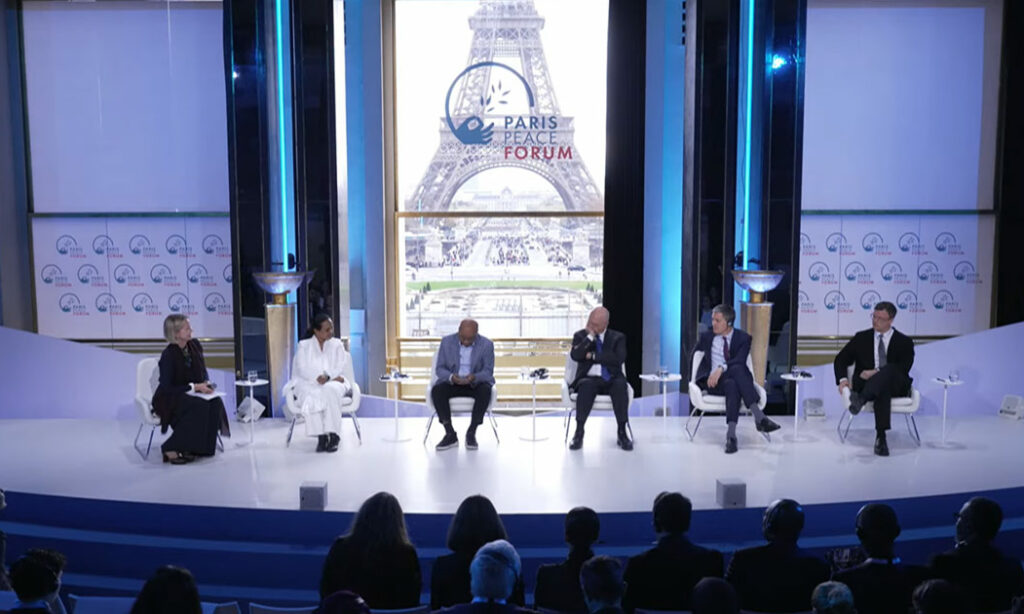
Paris Peace Forum 2026 — “Is Peace in Sudan Still Possible? Putting Civilians at the Center of the Process.” Stage A, Théâtre national de Chaillot, 11 November 2026, 12:00–12:45. Programme · Full video
In the fourth year of a war that has produced the world’s largest displacement crisis, a Sudanese women’s rights activist, a Sudanese-born business leader, two heads of humanitarian agencies and a European diplomat shared a stage in Paris. Their message was blunt: this is not a civil war left to burn itself out, but a conflict fed by foreign weapons, looted gold and a shrinking humanitarian budget. Below are their words, verbatim, followed by facts that put them in context.
An empty chair
Moderator Meredith Preston McGhie, Secretary General of the Global Centre for Pluralism, opened the session by pointing to an absent panellist, Abdullah Ibrahim, Project Manager at the Sudanese Youth Network (SYN):
“I would also note that we had invited a youth representative, Abdullah Ibrahim, from the Sudan Youth Network for Ending the War and establishing a civil democratic transition. He did not receive his visa to France, so he isn’t with us today, but is with us in spirit and has shared some of his thoughts that we will weave into the discussion.”
She then set the scene:
“The conflict in Sudan is characterized by one of the gravest humanitarian catastrophes in the world. Extraordinary levels of displacement inside the country and out, interests and direct involvement of regional and international players”
Context. The UN describes Sudan as the world’s largest displacement crisis. In June 2026, IOM counted about 8.8 million people internally displaced, with 4.4 million returnees (Sudan Tribune). Some 4.3 million Sudanese refugees remain in neighbouring countries, most of them in Egypt and eastern Chad (Radio Dabanga). OCHA puts the number of people in need of aid in 2026 at 33.7 million (OCHA).
“Military victory is impossible” — Tahani Abbas
Tahani Abbas, of the Nora Organization for Combating Violence Against Women and Girls, spoke first about the human toll (she spoke in Arabic; her words are quoted from the English interpretation):
“Through all these years over a 100,000 people have been impacted over 100,000 people have died. We’ve had over 16,000 rapes. We’ve had an extremely high number of people who’ve been displaced, who are refugees. Our country is the highest source of refugees worldwide. We’ve had the most number of displaced people”
She insisted that the war is not Sudan’s alone:
“I must say that this is not a uniquely Sudanese problem. there are international actors that are involved in this conflict and that are prolonging this conflict. So what I hope is that the two stakeholders in this conflict, the Sudanese forces and the RSF. I hope that these actors will stop being supplied with drones and military equipment. We have to be able to put pressure on these international actors to stop supplying these forces with equipment so that these killings can stop and these rapes can stop.”
And she pointed to what is at stake underground:
“And we also must not forget the geographical position of Sudan. We know that there are many resources, many natural resources including gold and other mineral deposits in Sudan. And so this has funded in fact the war in Sudan and the international community must put pressure on all involved actors for this war to stop. And military victory is impossible.”
Context. Aid workers estimate that the war has killed more than 200,000 people since April 2023 (AFP via Ahram Online). Documented sexual violence figures vary with who is counting, and all are considered underestimates: the UN Human Rights Office verified 546 incidents in 16 of Sudan’s 18 states (Radio Dabanga); MSF documented 3,396 cases in Darfur alone (MSF via allAfrica); a regional women’s initiative recorded around 1,900 cases between 2023 and December 2025 (Radio Dabanga). Most verified incidents are attributed to the RSF and allied militias, though the army and its allies are also accused.
The voice from the empty chair
Before giving the floor to Mo Ibrahim, Meredith Preston McGhie relayed the message of the absent Abdullah Ibrahim:
“But I do want to mention one thing from Abdullah Ibrahim, our colleague who is unable to get his visa: as you speak about Sudanese civilians in so many different places, one of the calls from young people is to invest in civilian consultations, that civilians need to be able to talk to one another, to engage with one another, to know one another, to deal with these difficult issues in order to be well positioned to engage in this process.”
The EU’s Luca Miehe would later echo that call, citing the civilian consultations as what gives him hope.
“Send us flowers, not bullets” — Mo Ibrahim
Mo Ibrahim, Founder and Chair of the Mo Ibrahim Foundation, denounced the world’s indifference:
“What’s happening in Sudan today is the worst humanitarian disaster in the world today. It is much more than Ukraine, much more than Gaza put together. The amount of human tragedy in Sudan. Of course, you don’t read about that and you don’t see about that. I mean, every morning I open newspaper, I watch the news. It is Ukraine, sometimes Gaza or West Bank, but Sudan…”
He described a country slipping out of anyone’s control:
“The problem is, very little aid going to Sudan, and the very little which goes to Sudan gets stolen before it reaches the refugee camps or anyway. Why? Because Sudan today is ungovernable land with so many militias. It’s not only the Rapid Support Forces and the army. We have so many militias and warlords. It becoming a mess.”
He then warned that the crisis will not stay within Sudan’s borders:
“What happens in Sudan will not stay in Sudan. Sudan is going to destabilize all the countries around it. We have seven countries around us and we will destabilize all that. We can see the problem is starting between Eritrea and Ethiopia. We see the problems in Chad, the Central African Republic already has a problem in the north with Sudanese forces there. So you look at the map and you see there is an arc of ungovernable land extending from the Atlantic, from the Sahel all the way to the Red Sea. This is an area much larger than Europe. And to our European friends, I mean you guys had a problem with few people from Afghanistan or from Syria who came as immigrants. You wait for the tsunami coming to you. Please wake up.”
Context. Arrivals in Europe are rising, though from a low base. Some 31,000 Sudanese applied for asylum in the EU between March 2025 and August 2026, making Sudan the bloc’s fifth-largest source of asylum seekers this year; 15,000 applied in the first eight months of 2026 alone, nearly two-thirds more than a year earlier, and two-thirds of decisions grant protection (EUAA via Sudan Tribune). The vast majority of those who flee stay in the region: Egypt and eastern Chad host most of the 4.3 million Sudanese refugees.
His sharpest words were for the arms suppliers:
“People need to understand that. And we have 11 countries. Eleven countries supplying weapons, drones to the two sides fighting there. And we ask those people, do you realize that these drones and these bullets are killing our people? What you guys are doing? You crazy? What is that? Eleven countries from Turkey to Iran to the Emirates to Saudi Arabia to Egypt to Pakistan, even Russia, all those guys. What you guys doing? And everybody proclaim love to Sudanese people. Okay, send us flowers, not bullets. And the only way to move forward is to take a firm stand. We need all these countries to stop supplying weapons to all parties in Sudan. That’s absolutely clear and that should be the demand put on the table.”
And for the resources that pay for them:
“Both side are extracting gold illegally to finance the war that should be labeled blood gold. You remember blood diamonds? That should be blood gold. It should be blood gum. The Arabic gum very essential that should be really blood goods that has to be stopped”
Context. A July 2026 report by the UN Human Rights Office found that gold is a major revenue source for both the army and the RSF, and that nearly 48% of Sudan’s 2024 gold output was smuggled out of the country (UN News). The same report says the RSF has diverted significant quantities of gum arabic from West Kordofan and Darfur towards South Sudan and other neighbouring markets (allAfrica). The first UN Panel of Experts on Sudan found “credible allegations” that the UAE was providing military support to the RSF through Chad (Human Rights Watch); the UAE denies this (Kuwait Times / AFP). The list of “11 countries” is Mo Ibrahim’s own count.
The diplomatic track — Luca Miehe
Luca Miehe, Head of Cabinet of the EU Special Representative for the Horn of Africa (European External Action Service), offered a more measured view:
“What I can offer now is to really share a little bit of the diplomatic side. Because the situation in Sudan is dire. We can’t disagree with that at all. But in the diplomatic space also, a lot has happened and I think you’ve very well described the complexity of the matter. Both of the actors within but also of the actors on the outside of Sudan surrounding them but also in the wider region. So yes, we see each other trapped in a lot of these big meetings by the UN, hosted by us, by others, but we are getting somewhere where we can think about a process. And if I compare where we are today and where we were 14 months ago, there’s a difference”
Context. “14 months ago” points to September 2025, when the Quad (United States, Saudi Arabia, Egypt and the UAE) proposed a roadmap: a three-month humanitarian truce, then a permanent ceasefire and a nine-month political transition (Sudan Tribune). The EU works through the Quintet (AU, EU, IGAD, Arab League and UN), which has consulted Sudanese civilian and political actors from Berlin to Addis Ababa and Khartoum; the EU says it wants progress on four fronts: a ceasefire, a civilian transition, humanitarian access and accountability (EEAS). In September 2026, the Quad and the Quintet met jointly in New York to coordinate humanitarian action, ceasefire diplomacy and civilian dialogue (Sudan Tribune). No truce is in force yet.
“A symptom of a syndrome” — David Miliband
David Miliband, President of the International Rescue Committee, refused to hide behind humanitarian neutrality:
“We shouldn’t use the commitment to neutrality and independence as an excuse for failing to speak truth to power. when it comes to political failure. And while it’s true that Sudan is uniquely bad in various ways, it’s certainly the largest crisis, we also have to recognize it’s a symptom of a syndrome. It’s a symptom of a syndrome in which hard power is unchallenged and diplomacy is in retreat. It’s a symptom of a situation where the war economy drives the fighting with far more strength than diplomacy drives the peace drive.”
He tied the crisis directly to aid cuts in donor capitals:
“The problem is that the effort is massively below the funding and the effort is massively below what is needed. We don’t have the excuse that we can’t reach people in Tawila. there are 900,000 people there but there’s massively the easy things are not being done and I think we have to therefore recognize that a further way in which the situation in Sudan is a symptom of global politics is that when you slash the global humanitarian aid budget by 50% and I’m sorry to say this but the French aid budget is falling the German aid budget is falling the British aid budget is falling the American aid budget has been decimated It’s not an accident that you end up with the disastrous situation where the lack of humanitarian aid actually it almost becomes an engine of further crisis and instability”
And he rejected the very label of “civil war”:
“Civil war sounds like, oh, neighbors are fighting with neighbors. This conflict did not start with neighbors fighting with neighbors. And it’s still not neighbors fighting with neighbors. It’s an instrumentalized conflict for power, for resources, for geopolitics. And you’re absolutely right to make the point that this is linked to the wider geopolitics of the Red Sea. And all those international actors who are sponsoring the conflict, this is in their top two, three or four foreign policy priorities. for those who are trying to stop the conflict. It’s not in the top 10 priorities.”
Context. About 800,000 displaced people have sought refuge in Tawila, some 60 km west of El Fasher, according to UN data (Sudan Tribune). OECD preliminary data show that official development assistance fell by 23.1% in 2025, the steepest drop on record: −56.9% for the United States, −17.4% for Germany, −10.9% for France and −10.8% for the United Kingdom (OECD); a further fall of 5.8% is expected in 2026 (The New Humanitarian). As of early November, less than half of the $2.9 billion humanitarian plan for Sudan had been funded (Africanews).
“There is nothing civil about this war” — Barham Salih
Barham Salih, UN High Commissioner for Refugees, admitted the shortfall:
“The little I know about the history of Sudan and I was talking to Mo before this panel. This is a rich country for agriculture, natural resources, also for human talent. It’s only when military took over power and disrupted what was for a while appear to be a promising prospects for our country. So coming back to the fundamental question that you have posed, we do have a horrendous humanitarian crisis. We need to be there to provide assistance for the people who need it. And I have to admit with I would say embarrassment and shame that what is available in order to deal with the humanitarian needs is nowhere near.”
“Remember there was a civilian government that was thrown out by allies who then became parties to this horrendous so-called civil war is there is nothing civil about this war. So I can only attest to what you have mentioned. There needs to be renewed international pressure to really bring this conflict to an end.”
Context. Barham Salih, a former President of Iraq and a former refugee himself, took office at UNHCR on 1 January 2026 (UNHCR). The “civilian government” he refers to is the transitional cabinet ousted in the October 2021 coup carried out jointly by the army and the RSF, who turned on each other in April 2023. In October 2025, the RSF took El Fasher, the last army stronghold in Darfur (EUAA).
After the session, Barham Salih wrote on X:
There can be no humanitarian solution to Sudan’s crisis without a political solution. This horrific humanitarian crisis must be brought to an end.
— Barham Salih (@BarhamSalih) November 11, 2026
At the @ParisPeaceForum, I stressed the imperative of a humanitarian ceasefire, an end to this devastating war, and a Sudanese-led path to lasting peace, supported by the international community.
Refugees and displaced Sudanese must have a voice in shaping that future, so families can return home in safety and dignity and rebuild their lives.
Throughout, @Refugees will remain steadfast alongside those forced to flee.
The question in the room: who will lead the UN?
From the floor, Hayley Davidson, Europe Director at Crisis Action, asked an uncomfortable question:
“Given that this crisis has to be very high on the priority list of the incoming secretary general, can the UN afford a secretary general who is coming from a government who is one of the 11 that was named by Mo as supplying arms and denying the findings of the UN independent expert reports.”
Nicholas Kristof of The New York Times pressed the same point:
“How can we possibly take seriously the diplomatic efforts of major powers when they are simultaneously discussing the appointment of an SG who for the past few years has been the prime apologist for the arms flow to one of those actors.”
Context. Neither questioner named the candidate. On 21 October 2026, the UAE nominated Lana Nusseibeh, its Minister of State, to succeed António Guterres, whose term ends on 31 December 2026. Human Rights Watch says she denied rights violations by the RSF and the findings of UN experts (HRW); Sudan’s UN mission has also opposed her candidacy (Sudan Tribune). She has pledged that Sudan would be her “number one priority” and that a Secretary-General takes instructions from no one.
The panel responds
Barham Salih answered without mincing words:
“There is a lot of money being made out of this and you simply cannot dissuade some of these actors out of their ill-gotten gains by just being nice. Seriously. And furthermore, I think what you have here, you have horrendous war crimes that have been committed. The notion of impunity for people to get away with the terrible crimes that have been committed is really bad omen for not just Sudan, for the world at large.”
David Miliband turned to the UN’s machinery:
“Obviously ending the war is critical but in significant parts of the country the war has ended but the violence perpetrated against civilians is a continuing scar on their lives. And the reality is that we have a divided Sudan at the moment […] Every one of the 11 sponsors of different parties to the conflict has major relations with powers around the world. The question is whether those powers are willing to leverage the relations they have […] I’m not going to get drawn into who should be the UN Secretary General. We’re a humanitarian agency […] There is a proposal with now the support of 128 countries. It’s led by France and Mexico to suspend the veto in the UN in cases of mass atrocity of which Sudan would be an obvious example. And one of the concerns I have is that the granular nature of the disaster in Sudan is divorced from the institutional politics.”
Context. The French-Mexican initiative on veto restraint in cases of mass atrocities reached 128 supporting states in September 2026, when the United Kingdom became the second permanent Security Council member to join, after France (Malay Mail / AFP).
During the session, Miliband declined to discuss candidates. The next day, he set out on X what he expects from the next Secretary-General:
During a talk on Sudan at the @ParisPeaceForum yesterday, I was asked about the new UN Secretary-General.
— David Miliband (@DMiliband) November 12, 2026
Here’s what I know: If we are to end conflicts like Sudan, we need an activist, determined Secretary-General of the UN who doesn’t mind risking failure in order to try and achieve success.
You can watch the full conversation here: youtube.com/watch?v=sbdUfkrVHrc
Luca Miehe defended dialogue:
“The reality is also that those that are involved in the war will also need to be part of the discussion. You don’t negotiate with your friends, you negotiate with your enemies. And so the formats that exist now, they need to be used, but evidently they need to be used more effectively and different. But what gives me hope is to be in these civilian consultations and to see that in the fourth year of the war people like Tahani, people like Mo are still pushing on these lines and we can see on the diplomatic side there is pressure but there’s also a discussion about what has not worked and there’s a discussion about how we can design and improve the coordination which will mean also an increase of pressure.”
Mo Ibrahim was not convinced:
“I really appreciate what our friends in Europe are trying to do. It’s a very nice people. The problem is they lack backbone you know we need some more assertion really to stop this war people not to call out the guys I haven’t heard any European leader calling out any of those 11 countries say guys stop that this is criminal what you are doing this is a crime against humanity and we have to take action against you it is sad said that we only now hope is really Donald Trump for all his faults. At least he has a backbone […] If he wants a Nobel Prize, stop the war in Sudan. That get you a Nobel Prize. Okay? Don’t go to war in Iran. Stop the war in Sudan. Then you have the right to ask for a Nobel Peace Prize. But we need action. People to stand up and say what is happening there is criminal. Did Europe do any of that stuff? No. Only talk. Let us persuade the people.”
Context. In November 2025, Donald Trump pledged to work on ending the war at the request of Saudi Crown Prince Mohammed bin Salman, alongside Saudi Arabia, the UAE, Egypt and other partners (Al Jazeera); he has openly sought the Nobel Peace Prize. The reference to Iran concerns the US-Israeli strikes on Iran launched in late February 2026 (Asharq Al-Awsat).
The last word went to Tahani Abbas:
“We know that many states are giving humanitarian support on one hand and arms on the other. So as Sudanese activists, we know that peace in Sudan represents peace in the whole world as well. Sudan is at a crossroads by its geographical position and so the international community must be ashamed of allowing the RSF and the Sudanese army to be furnished with weapons and even with fighters. They must be ashamed because that money is used to rape women, to kill civilians, to displace thousands of people from their homes […] We have millions of Sudanese refugees that are living in abhorrent conditions. It’s a shame. It should be a shame for these countries that are feeding this war. And history will remember, historians will remember this shame for these countries that are feeding this war that are killing so many of our loved ones.”
“As Sudanese women, we have shown so much courage and resilience. Women and girls in Sudan have shown courage and they’ve shown this resilience and that is a good thing. However, we have no political support for the Sudanese people. I’d like to have a young Sudanese person here. But he wasn’t able to get his visa for France. So that is a perfect symbol of what is happening here. You are allowing the rape and the murder of Sudanese people of Sudanese girls and women’s that are ending up in slave markets in neighboring countries.”
Context. The UN Human Rights Office has documented at least 85 women and girls held in sexual slavery and forced into domestic labour or income generation (allAfrica / OHCHR).
What comes next
The next weeks will test what was said in Paris. The Security Council must recommend a new Secretary-General before António Guterres leaves office on 31 December; a candidate needs nine votes and no veto from a permanent member (Khaleej Times). The Quad’s humanitarian truce, announced more than a year ago, has yet to take hold. And on the ground, aid is running out: IOM’s Sudan chief said in early November that the agency’s warehouses were empty (TimesLIVE / Reuters).
The panel agreed on one thing: as long as weapons and money keep flowing in, the war will not end on its own. The empty chair left by Abdullah Ibrahim, the young Sudanese who never got his visa, was perhaps the clearest answer to the session’s question. His message asked for something simple: space for Sudanese civilians to talk to one another. Peace will not be possible without them at the table.
Quotes are reproduced verbatim from the session, with transcription errors corrected against the video; hesitations (“uh”, “um”) and false starts have been removed, and […] marks passages left out. Views expressed are the speakers’ own. Context paragraphs are written by The MagkaSama Project.
Sources
- Paris Peace Forum — Programme, 11 November 2026 · Session video
- Radio Dabanga — 4.3 million Sudanese refugees in the region · OHCHR report on sexual violence · Sexual violence documentation
- Sudan Tribune — IDPs fall to 8.8 million · New wave of displacement to Tawila · Sudan opposes UAE candidate · Quad proposes 3-month truce, 9-month timeline · Quad–Quintet meeting and the next truce · 31,000 Sudanese sought asylum in the EU
- UN OCHA — Sudan humanitarian response 2026
- UN News — Looted gold and gum arabic are bankrolling Sudan’s war
- OECD — Preliminary ODA levels in 2025
- Human Rights Watch — UAE: UN Secretary-General candidate whitewashed abuses
- UNHCR — Statement by Barham Salih upon his election
- EEAS — EU statement at the UN Security Council on Sudan, 14 September 2026
- Al Jazeera — Trump pledges ‘cooperation and coordination’ to end Sudan’s civil war
- Khaleej Times — Lana Nusseibeh announces UN chief bid
- AFP via Ahram Online — Over 5 million displaced Sudanese return home
- MSF via allAfrica — 3,396 cases of sexual violence documented in Darfur
- Africanews — UN struggling to help millions find shelter
- TimesLIVE / Reuters — Millions of displaced Sudanese risk losing shelter
- Malay Mail / AFP — UK joins 128-nation push to curb UN vetoes
- EUAA — Sudan country focus